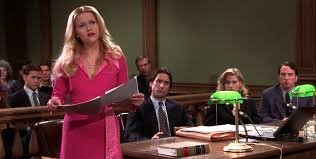
When we think of iconic early 2000s cinema, the image of a bright pink suit standing tall in a highly serious trial instantly comes to mind. The famous legally blonde court showdown is not just a masterclass in pop culture nostalgia; it is also a fascinating subject for legal professionals who love to analyze Hollywood’s interpretation of justice. For decades, viewers have debated whether a fashion-obsessed sorority girl could truly maneuver the complexities of a high-stakes murder trial with such flair.
Beneath the glittering comedy and the famous “bend and snap” routine, the movie actually hides a remarkably solid foundation of legal strategy. Many modern law students still watch these scenes to find motivation before their daunting final exams. If you are a fan of legal dramas, you might also want to check out our comprehensive list of the best lawyers films intense courtroom battles that keep viewers on the edge of their seats.
Today, we are putting away the pink scented paper and diving straight into the hardcore facts. We will be busting some myths and educating you on why the underlying mechanics of this beloved movie actually prove that our favorite blonde protagonist possessed the genuine instincts of a top-tier litigator. Grab your favorite iced coffee, and let us dissect the reality behind the fabulous fiction!
Analyzing The Legally Blonde Court Scene, 8 Facts About Elle Woods!

To truly appreciate the cinematic brilliance of this film, we must look at the specific details that mirror real-life legal practices. Based on legal analysis, here are eight crucial facts that separate the Hollywood drama from actual courtroom procedure.
1. Grasping Mens Rea And Basic Legal Arguments
Right from the beginning, the movie establishes that our protagonist is not just a pretty face but someone capable of understanding foundational legal concepts.
- In the opening trial scene, Elle specifically mentions mens rea, which is indeed a core concept in criminal law representing the “guilty mind” or intent of the accused.
- Although the film simplifies how this concept is applied for the sake of the audience, her usage of the term shows a solid grasp of basic legal arguments.
- Understanding intent is the first step in building a strong defense, proving she was paying attention to the core principles of her education.
2. The Brutal Reality Of The Socratic Method
Law school is notoriously stressful, and the movie captures this high-pressure environment perfectly during the classroom scenes.
- The fast-paced question-and-answer sessions in her law classes feel highly realistic.
- This technique is known as the Socratic method, where professors relentlessly press students with rapid and difficult questions.
- This intense environment is a staple of the Elle woods law school reality, forcing students to think on their feet and defend their positions under extreme pressure.
3. The Genuine Feeling Of Not Fitting In
Imposter syndrome is a massive psychological hurdle for anyone entering a highly prestigious academic institution.
- The feeling of “not fitting in” at law school is incredibly real.
- Many law students genuinely feel intimidated by the highly competitive environment.
- Therefore, Elle’s initial experiences with the toxic campus culture and feeling alienated are not entirely fabricated for dramatic effect.
4. Cutthroat Competition For Prestigious Internships
Getting a good grade is only half the battle; securing a spot at a top firm is where the real war begins.
- The fierce competition for internships is a very real aspect of legal education.
- The film accurately portrays that securing a legal internship position can be highly competitive.
- These positions are crucial for law students, as they often dictate the trajectory of their future careers in the legal field.
5. Mastering Observational Skills For Cross-Examination
A good lawyer does not just read books; they read the room. This is where her background in fashion and socializing becomes a lethal weapon.
- Elle possesses the ability to read her conversational counterparts very quickly.
- Her advantage is not merely her fashion sense; she meticulously observes details about people and situations.
- In actual legal practice, this sharp attention to human detail is a critical skill required for effective cross-examination.
6. The Unrealistic 1L Control In A Murder Trial
While we love the climax of the movie, we have to admit that Hollywood took some massive creative liberties regarding a student’s authority.
- The courtroom portion of the movie is arguably the most unrealistic aspect.
- A first-year law student (1L) would almost certainly never be given major control over a high-stakes murder case in a real court.
- Despite how iconic the Legally Blonde courtroom scene is, real-life judges would never allow an unlicensed student to take the lead in such a critical moment.
7. Breaking Down The Confessions And Surprise Witness Laws
The dramatic twist where the true culprit breaks down on the stand makes for amazing television, but it heavily skews public perception of how trials work.
- A sudden witness confession in the middle of a trial is far too dramatic.
- In actual practice, surprises like this usually emerge much earlier during the case procedure (such as during discovery), rather than as a sudden “plot twist” in the courtroom.
- Real trials are meticulously planned, and lawyers rarely ask a question to which they do not already know the answer.
8. Questionable Ethics But Brilliant Legal Instincts
Her methods were unconventional and sometimes crossed the line, but her core instincts were undeniably sharp.
- Her professional ethics are problematic, but her legal instincts are genuinely excellent.
- In the real world, a law student or prospective lawyer would not be free to violate procedures and get away without severe consequences.
- However, the way she constructs arguments and identifies the weaknesses of a witness demonstrates very strong litigation potential. Ultimately, she looks great as a lawyer because she possesses three essential traits: confidence, observational skills, and the courage to speak in public. The film may not be 100% accurate, but it successfully shows that underestimated people can be highly competent.
Decoding The Harvard Law Student Requirements And Academic Struggles
Beyond the flashy trial, the movie also touches on the gruelling journey of getting into one of the most prestigious universities in the world. The transition from a fashion merchandising major to a top-tier legal scholar is not just a montage of studying in a bikini; it represents a monumental academic shift.
The Myth And Reality Of LSAT Scores
When the movie reveals that she scored a 179 on her LSAT, real lawyers everywhere gasped.
- A score of 179 is literally in the top 0.1% of all test-takers globally.
- Meeting the real harvard law student requirements demands an astronomical LSAT score and an impeccable undergraduate GPA.
- While her video essay was hilarious and definitely unconventional, in the real world, admissions officers prioritize the hard numbers and analytical reasoning skills above all else.
Navigating The Elle Woods Law School Reality As A First Year
The first year of law school, commonly known as 1L, is designed to break you down and rebuild how your brain processes information.
- The rigorous reading assignments shown in the movie accurately reflect the hundreds of pages students must consume nightly.
- The Elle woods law school reality highlights how students are taught to strip away emotion and focus purely on the cold, hard facts of jurisprudence.
- Study groups are portrayed as essential survival mechanisms, which is entirely true for anyone trying to survive their first year of legal academics.
Balancing Social Life And Intense Legal Studies
One of the most relatable aspects of her journey is the isolation that comes with intense academic dedication.
- The movie shows her sacrificing parties and social events to highlight text in her dorm room.
- This accurately depicts the sacrifice required by the stringent harvard law student requirements, where social lives often take a back seat to constitutional law.
- It proves that regardless of your background, hard work and relentless dedication are the true equalizers in higher education.
Examining The Cross Examination Rules And The Legal Accuracy Of Movies

The climax of the film revolves around a brilliant deduction involving a permanent wave (a “perm”) and ammonium thioglycolate. While it is a cinematic masterpiece, how does it hold up against the strict rules of evidence?
Hollywood Drama Vs Strict Court Procedures
Hollywood loves a good “Gotcha!” moment, but real judges despise them.
- When evaluating the overall legal accuracy of movies, it is important to note that actual trials are incredibly slow and highly bureaucratic.
- Lawyers cannot simply pace around the courtroom making dramatic speeches without facing constant objections from the opposing counsel.
- The judge in the movie is remarkably lenient, allowing a first-year student to essentially hijack a cross-examination without immediate reprimand.
Is Legally Blonde Court Scene Accurate To Real Procedure?
If we ask the question, Is Legally Blonde court scene accurate, the answer is a mix of yes and no.
- The logic behind her questioning—using specialized knowledge to poke holes in a witness’s alibi—is a highly accurate representation of good litigation tactics.
- However, the procedural aspects, such as a student directly questioning a hostile witness in a murder trial, completely violate real-world cross examination rules.
- In reality, an experienced supervising attorney would have had to ask those questions based on her brilliant insights.
Managing Evidence And The Truth About Surprise Witness Laws
The dramatic breakdown on the stand is a classic trope, but it heavily misrepresents how evidence is handled.
- Real surprise witness laws strictly dictate that all evidence and potential witness testimony must be shared with the opposing counsel during the discovery phase.
- If a lawyer truly ambushed a witness with entirely new evidence on the stand, it could result in a mistrial.
- Despite these procedural flaws, the Legally Blonde courtroom scene remains a fantastic educational tool to teach students how to identify inconsistencies in a witness’s timeline.
Q&A
When you watch a legally blonde court clip on YouTube, why do real lawyers always praise the perm scene despite its flaws?
Real lawyers absolutely love the perm scene because it perfectly demonstrates the value of bringing outside, specialized knowledge into the courtroom. It shows that a lawyer does not just need to know the law; they need to know the facts of the real world. Her deep knowledge of haircare chemistry was the ultimate weapon, proving that every piece of a lawyer’s life experience can be useful in a trial.
In terms of strict legal practice, Is Legally Blonde court scene accurate when it comes to the way she dresses?
Not exactly. While individuality is celebrated, most judges enforce a very strict dress code that requires conservative business attire. Showing up in a bright pink suit might technically be allowed depending on the specific judge’s temperament, but it would likely draw severe criticism or even a contempt warning in a highly traditional courtroom.
How does this movie compare to the general legal accuracy of movies released in the same era?
Surprisingly, it holds up much better than many gritty thrillers! While the procedural cross examination rules were bent for dramatic effect, the underlying logic of her arguments was solid. Unlike action-heavy legal thrillers that rely on shootouts or illegal evidence gathering, this movie relied on genuine observational skills and logical deduction, making it a surprisingly respectable piece of legal fiction.