Running for public office in the United States is a grueling, exhilarating, and highly scrutinized endeavor. It takes far more than just a charismatic smile and a handful of good ideas to win an election. Behind the scenes of every successful rally, televised debate, and viral social media post, navigating the strict web of political campaign laws is the true test of a candidate’s viability.
The Federal Election Commission (FEC) and various state regulatory boards maintain a hawk-like watch over how money is raised, how advertisements are framed, and how data is utilized. A single administrative misstep or improperly filed disclosure can derail a promising candidacy, leading to massive fines or career-ending scandals.
Whether you are a grassroots organizer aiming for a local city council seat or a seasoned operative managing a federal congressional run, understanding the intersection of law and politics is absolutely non-negotiable. If you are deeply interested in the theoretical background that shapes these regulations, you might want to check out this perfect law and politics book to supplement your practical knowledge.
In this comprehensive guide, we will break down the complex legal frameworks that govern modern elections. We will explore financial compliance, draw lessons from historical races, and outline legal strategies that will keep your campaign running smoothly and successfully.
Navigating The Complexities Of Political Campaign Laws

Ignorance of the law is never a valid defense in politics. Even the architects of Famous political campaigns had to start by memorizing the federal and state rulebooks before printing their first yard sign. Let us dive into the foundational legal concepts you must master.
1. Defining The Political campaigns meaning Under Federal Regulations
In common conversation, a campaign is just a push for votes. However, the legal Political campaigns meaning is far more precise. Under FEC guidelines, an individual becomes a legally recognized “candidate” once they (or persons authorized by them) receive contributions or make expenditures exceeding $5,000.
- Once this financial threshold is crossed, federal law triggers mandatory registration.
- You must designate a principal campaign committee within 15 days.
- Failure to officially define your campaign’s status while raising funds is a direct violation of federal statutes.
2. Strict Financial Contribution Limits And Rules
Campaign finance is arguably the most heavily policed area of election law. The Bipartisan Campaign Reform Act (BCRA) tightly regulates who can give money and how much they can give.
- Individual Limits: As of the recent election cycles, an individual can only donate up to a specific limit (e.g., $3,300 per election) directly to a candidate’s committee.
- Corporate Bans: Corporations and labor organizations are strictly prohibited from making direct monetary contributions to federal candidates.
- PACs and Super PACs: While traditional Political Action Committees (PACs) have strict contribution limits, Super PACs can raise unlimited funds. However, it is entirely illegal for a Super PAC to coordinate its strategy or advertising directly with the candidate’s official campaign.
3. Transparency In Advertising And Media
Every piece of public communication designed to influence an election must carry a legal disclaimer.
- The “Stand By Your Ad” Provision: Television and radio ads must include a clear audio and visual statement identifying who paid for the ad (e.g., “I am John Doe, and I approve this message”).
- Print and Digital Media: Billboards, mass emails (over 500 identical emails), and social media blasts must clearly state who funded the communication. Omitting these disclaimers can result in swift and severe financial penalties.
Lessons Learned From Famous Political Campaigns

To truly grasp the Political campaigns meaning and how regulations shape outcomes, one must look back at history. The most successful politicians did not just have charisma; they utilized Political campaign strategies examples that redefined voter engagement while staying flawlessly within legal boundaries.
1. Analyzing Historical Successes and Compliance
Look back at the 2008 Obama campaign, which revolutionized small-dollar fundraising. Legally, managing millions of $5 and $10 donations was a logistical nightmare. The campaign had to employ rigorous accounting software to ensure that no individual donor accidentally exceeded the federal maximum limit through repeated small donations. Their success proved that massive scale requires massive legal compliance infrastructure.
2. Analyzing Modern Political campaigns examples
In recent years, we have seen excellent Political campaigns examples centered around digital compliance. Campaigns now rely heavily on text messaging to raise funds. However, they must strictly adhere to the Telephone Consumer Protection Act (TCPA). Sending automated text messages to voters who have not explicitly opted in is a direct violation of federal law, a mistake that has cost sloppy campaigns millions in class-action lawsuits.
3. The Legal Pitfalls To Avoid
History is also littered with cautionary tales. The misuse of campaign funds for personal expenses is a strict liability offense. Buying a personal wardrobe, paying for a family vacation, or utilizing donor money to cover personal legal settlements are fast tracks to federal indictment. The line between a “campaign expense” and a “personal expense” must be guarded fiercely by a competent campaign treasurer.
Formulating Innovative Political Campaign Strategies Examples
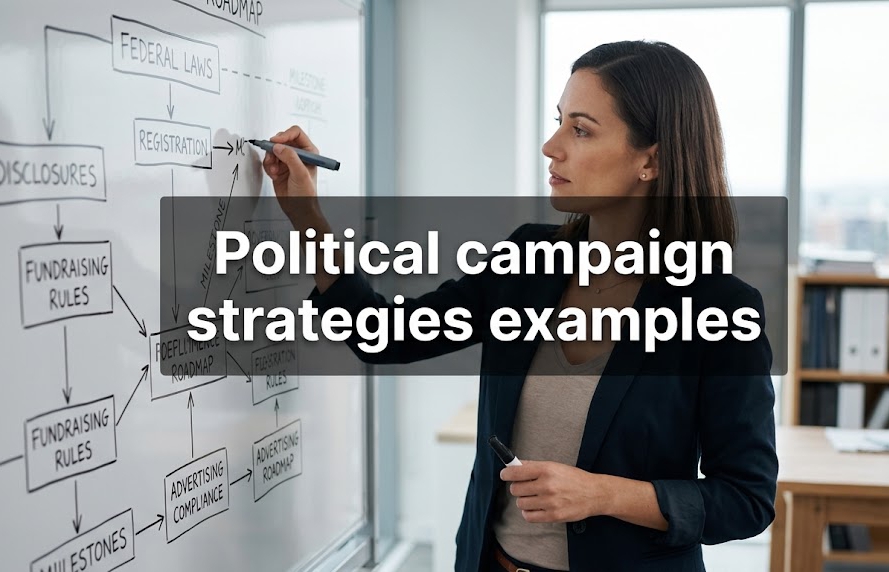
Structuring your Election campaign points around a solid legal framework does not mean your outreach has to be boring. When reviewing various Political campaigns examples, it becomes clear that creativity thrives under constraint. Here is how you can innovate legally.
1. Generating Compliant Political campaign ideas
One of the most effective Political campaign ideas is peer-to-peer fundraising. Instead of hosting expensive gala dinners, campaigns empower supporters to host smaller, independent house parties.
- The Legal Catch: The campaign must provide strict guidelines to the hosts. If the host spends over a certain amount on food and drinks for the event, it counts as an “in-kind contribution” and must be legally reported to the FEC.
2. Digital Outreach And Data Privacy Laws
Data is the lifeblood of modern political strategy. However, how you acquire and use voter data is heavily regulated.
- If you are sending campaign emails, you must comply with the CAN-SPAM Act, ensuring every email has a clear, functional “unsubscribe” link.
- Utilizing third-party data brokers to build voter profiles is legal, but sharing personally identifiable information (PII) of your donors maliciously or recklessly can trigger state-level privacy laws like the CCPA in California.
3. Grassroots Mobilization Tactics
Door-to-door canvassing remains a gold standard for voter mobilization. From a legal standpoint, political canvassing is protected under the First Amendment. Canvassers can legally bypass “No Soliciting” signs in many jurisdictions because political speech is not commercial speech. However, campaign managers must train volunteers to respect local trespassing laws and private property boundaries to avoid negative PR and police involvement.
Establishing Strong Election Campaign Points
You might have the most brilliant Political campaign ideas, but if your core message contradicts local ordinances or alienates your donor base, you will not win. Formulating your Election campaign points requires a blend of ideological passion and legal pragmatism. Whether you are promising tax reform, infrastructure development, or educational overhauls, your promises must reflect a true understanding of jurisdictional power. Promising a federal policy change while running for a municipal mayoral seat will make you look legally illiterate to educated voters.
Furthermore, adhering strictly to political campaign laws ensures your platform remains untarnished by scandal. A great message is easily drowned out by an FEC audit. To ensure your campaign operates flawlessly, keep this compliance checklist in mind:
- Hire a Certified Treasurer: Never manage your campaign finances yourself. Appoint a professional who understands FEC reporting schedules implicitly.
- Separate Bank Accounts: The moment you decide to run, open a dedicated campaign bank account. Never commingle personal funds with political donations.
- Vett Your Vendors: Ensure the marketing agencies and consultants you hire have a proven track record of political compliance, particularly regarding digital ad disclosures.
- Document In-Kind Contributions: Office space, donated catering, and pro-bono consulting services hold monetary value and must be accurately reported as contributions.
- Implement Data Security: Protect your voter files and donor lists with enterprise-grade encryption to prevent data breaches that could trigger federal privacy investigations.
| Compliance Category | Must-Do Action | Legal Risk if Ignored |
| Financial Reporting | File quarterly FEC reports on time | Heavy fines and public audits |
| Media Advertising | Include “Paid for by…” disclaimers | Ads pulled from networks; FCC fines |
| Voter Outreach | Obtain opt-ins for SMS marketing | TCPA class-action lawsuits |
| Contribution Limits | Refund excess donations within 60 days | Accusations of illegal fundraising |
Q&A
Can a candidate use their own personal wealth to fund their political campaign entirely?
Yes. Under the Supreme Court ruling in Buckley v. Valeo, spending your own money on your own political campaign is considered a protected form of free speech. There are no federal limits on how much of your own personal wealth you can inject into your principal campaign committee. However, you must still legally report these funds as contributions and loans from the candidate to the committee on your public FEC filings.
Is it legal for foreign nationals to donate to a US political campaign?
Absolutely not. The Federal Election Campaign Act (FECA) strictly prohibits foreign nationals from contributing, donating, or spending funds in connection with any federal, state, or local election in the United States. Furthermore, campaigns are legally barred from soliciting, accepting, or receiving such contributions. The only exception is for individuals who possess a valid “Green Card” (lawful permanent residents).
What happens to the leftover campaign money if a candidate loses the election or retires?
FEC rules strictly dictate how surplus campaign funds can be utilized. You cannot simply pocket the remaining money for personal use. Legal options include holding the funds for a future run for the same or different office, donating unlimited amounts to a recognized charitable organization, transferring the funds to a national, state, or local political party committee, or refunding the money directly back to the original contributors.